ROI Guidance
What buyers actually pay more for
Not every dollar you spend on your home comes back at sale. Here's how to tell the difference — and where our case studies prove it.
The renovation trap most sellers fall into
Most sellers renovate based on what they love about their home — or what a contractor recommends. The problem is that buyers don't pay for what you love. They pay for what removes doubt, signals quality, and makes the home feel move-in ready.
The difference between a renovation that returns 300% and one that returns 60% isn't the quality of the work — it's whether the work addressed what buyers actually care about.
Return on Investment by Item
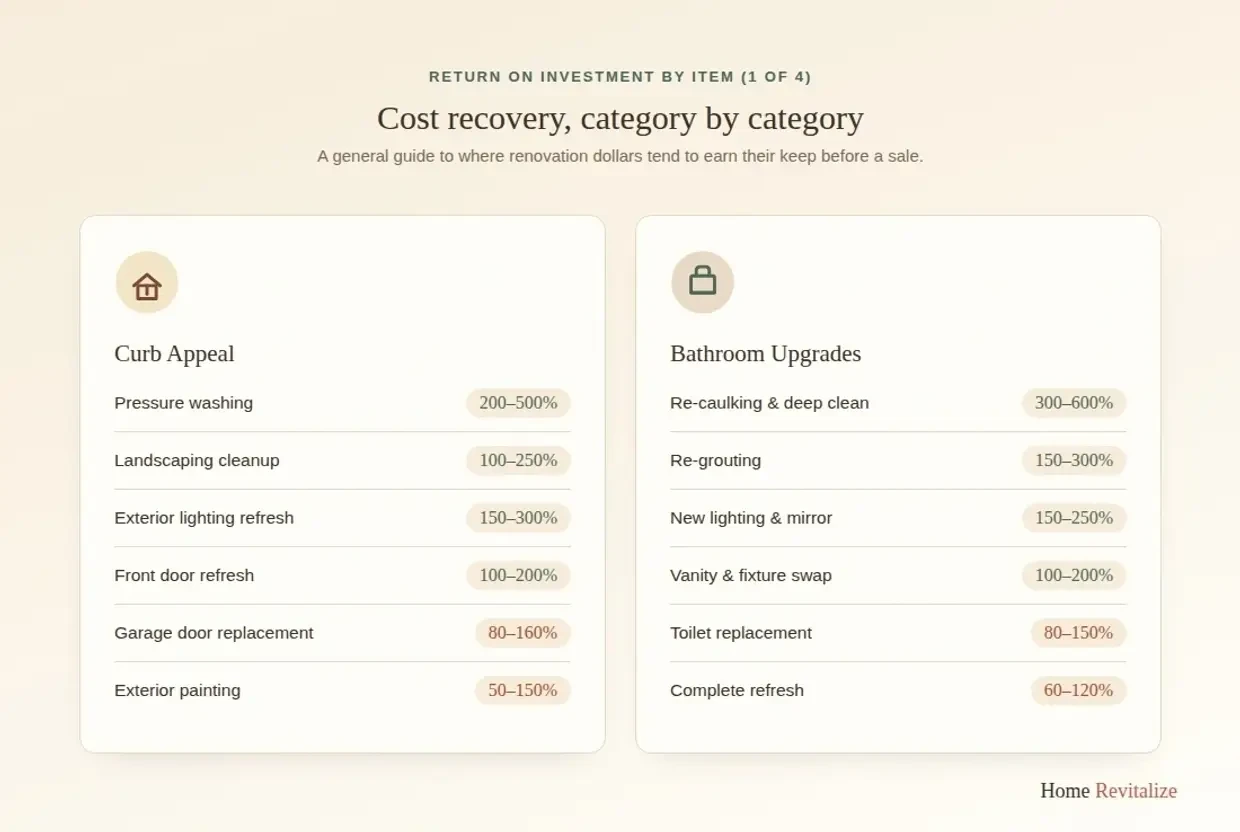
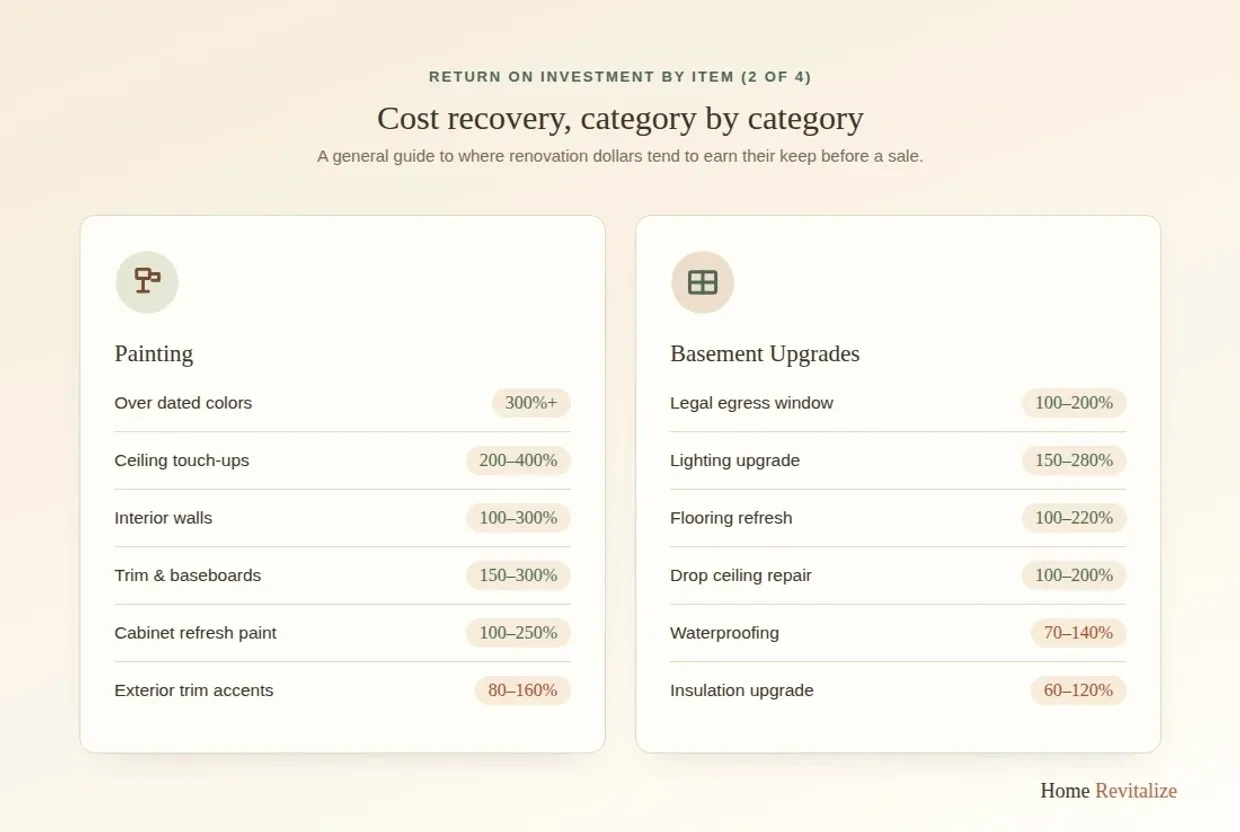
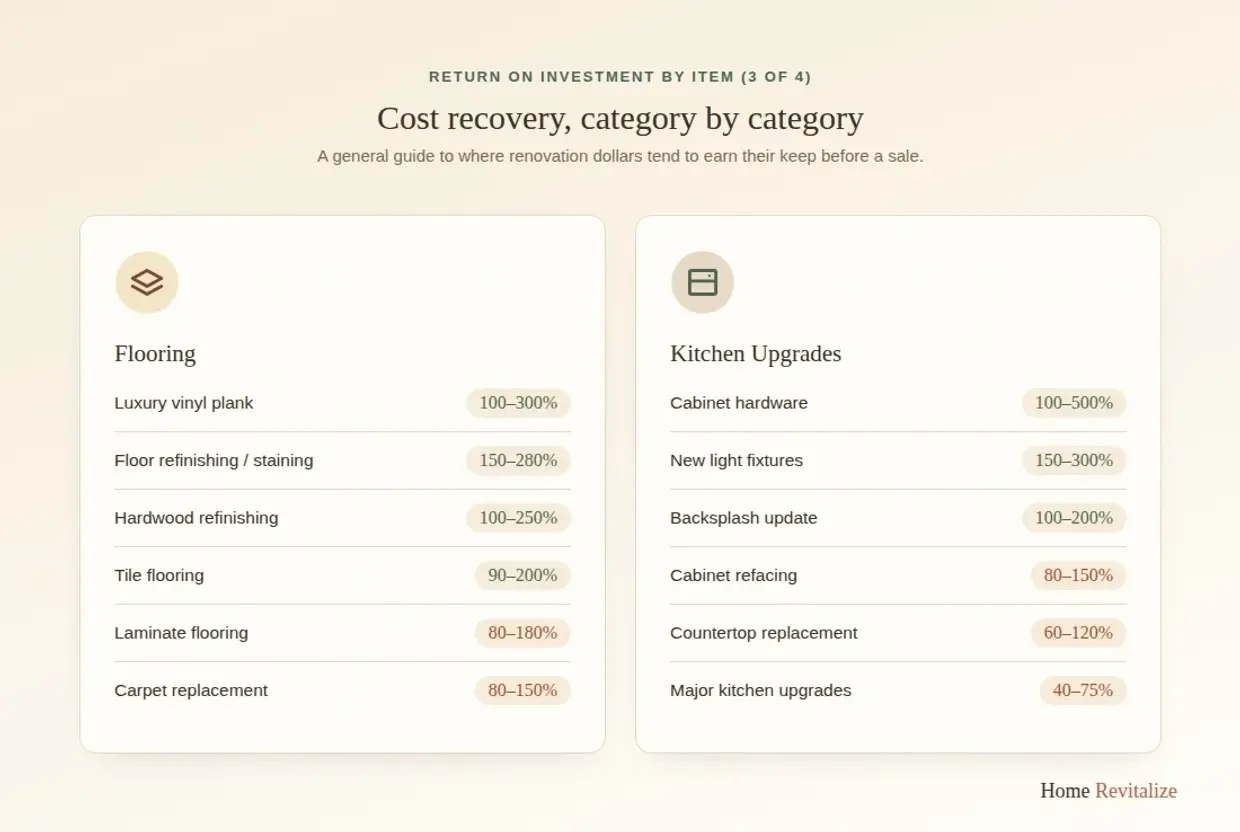
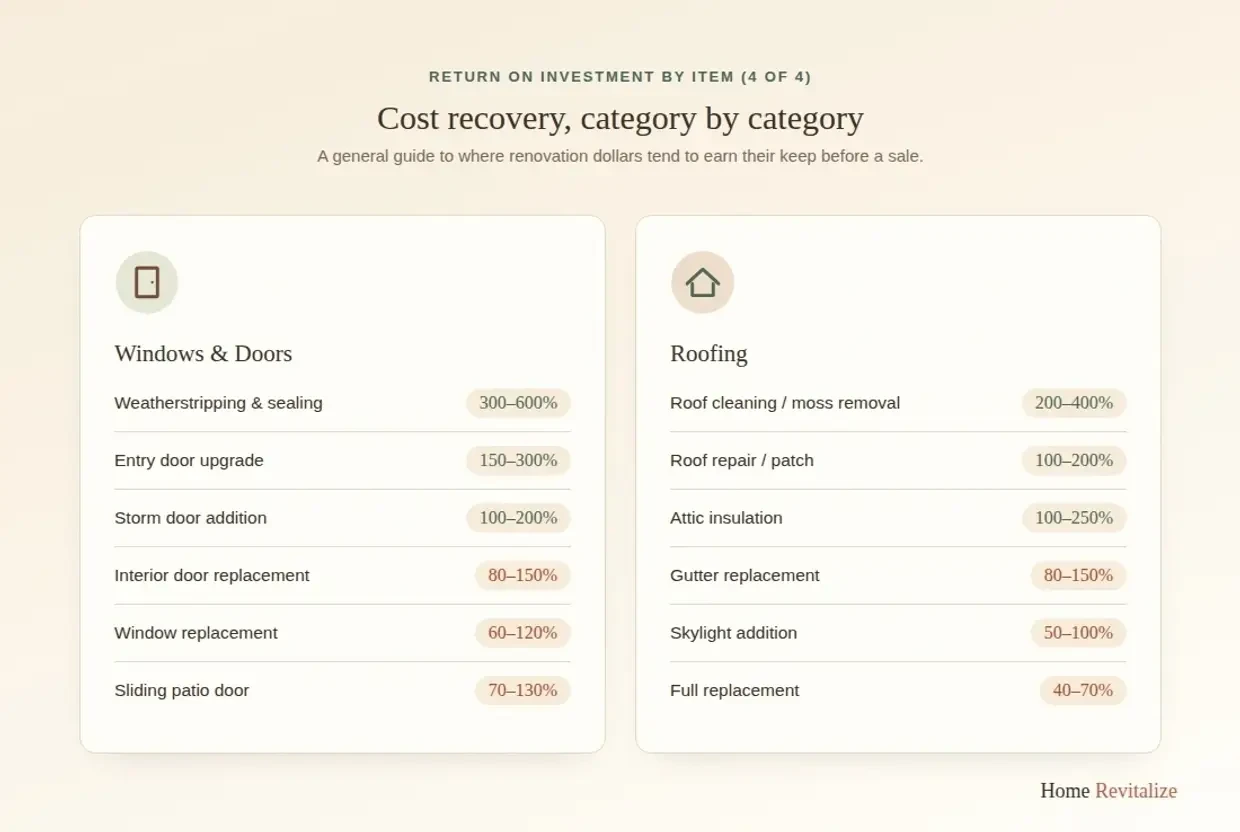
Cost recovery, category by category
A general guide to where renovation dollars tend to earn their keep before a sale.
These percentages represent estimated value recovered relative to cost, not guaranteed profit. A range of 100–300% means a $1,000 improvement may add roughly $1,000–$3,000 in resale value — actual results vary by property, market, and execution.
What buyers pay more for
First impressions that hold up
Buyers form a price in their head before they walk through the door. Curb appeal, entry condition, and the first 30 seconds inside set an anchor that's nearly impossible to shift upward later.
Kitchens and bathrooms that feel clean and current
These rooms don't need to be renovated — they need to not feel dated or neglected. A $400 re-caulk and deep clean can return more than a $15,000 tile job.
Neutral, move-in-ready finishes
Buyers discount heavily for work they'll have to do themselves. Neutral paint, clean flooring, and updated fixtures remove that mental deduction before they make an offer.
Mechanical and structural confidence
A buyer who worries about the roof, furnace, or foundation will either walk away or low-ball. Addressing visible concerns — even cosmetically — removes the biggest negotiating leverage buyers have.
Cohesive presentation across the whole property
One beautifully renovated room next to a neglected one creates doubt. Buyers pay a premium when the whole property signals consistent care — not just the rooms that were staged.
What this looks like in practice
$18K
Invested
$55K value increase
Case Study 01
$22K
Invested
$40K above estimate
Case Study 02
$5K
Invested
Sold in 9 days
Case Study 03
$95K
Invested
Sold $850K in 3 days
Case Study 04
What doesn't move the needle
These are the renovations sellers most commonly over-invest in — improvements that feel significant but rarely return their cost at sale.
High-end appliance upgrades
Buyers notice appliances, but they don't pay proportionally for premium brands. A clean, functional kitchen with mid-range appliances outperforms a dated kitchen with a $3,000 fridge.
Luxury finishes in entry-level markets
Marble countertops and heated floors don't return their cost when the comparable sales in the neighbourhood don't support that price point. The market sets the ceiling — finishes don't raise it.
Swimming pools and major additions
Pools are a liability in most Canadian markets — they narrow your buyer pool and add ongoing cost concerns. Major additions rarely return more than 50–60 cents on the dollar.
Highly personalized design choices
Bold wallpaper, custom built-ins, and unique tile patterns reflect your taste — not the buyer's. Personalization that can't be easily changed becomes a discount, not a premium.
Over-improving for the street
The most expensive home on the block is the hardest to sell. Improvements that push your property above neighbourhood comparables rarely recover their full cost — buyers anchor to what else is available nearby.
The core principle
Not every renovation creates value. The goal is to identify improvements that best support property goals, attract buyers, and maximize ROI before listing.
Before you spend a dollar renovating, spend 60 minutes with us. Our property strategy session identifies exactly where your money will work hardest — and where it won't.
Get a strategy before you spend a dollar
We'll walk through your property, identify the highest-return opportunities, and give you a clear plan — before any contractor quotes start arriving.